
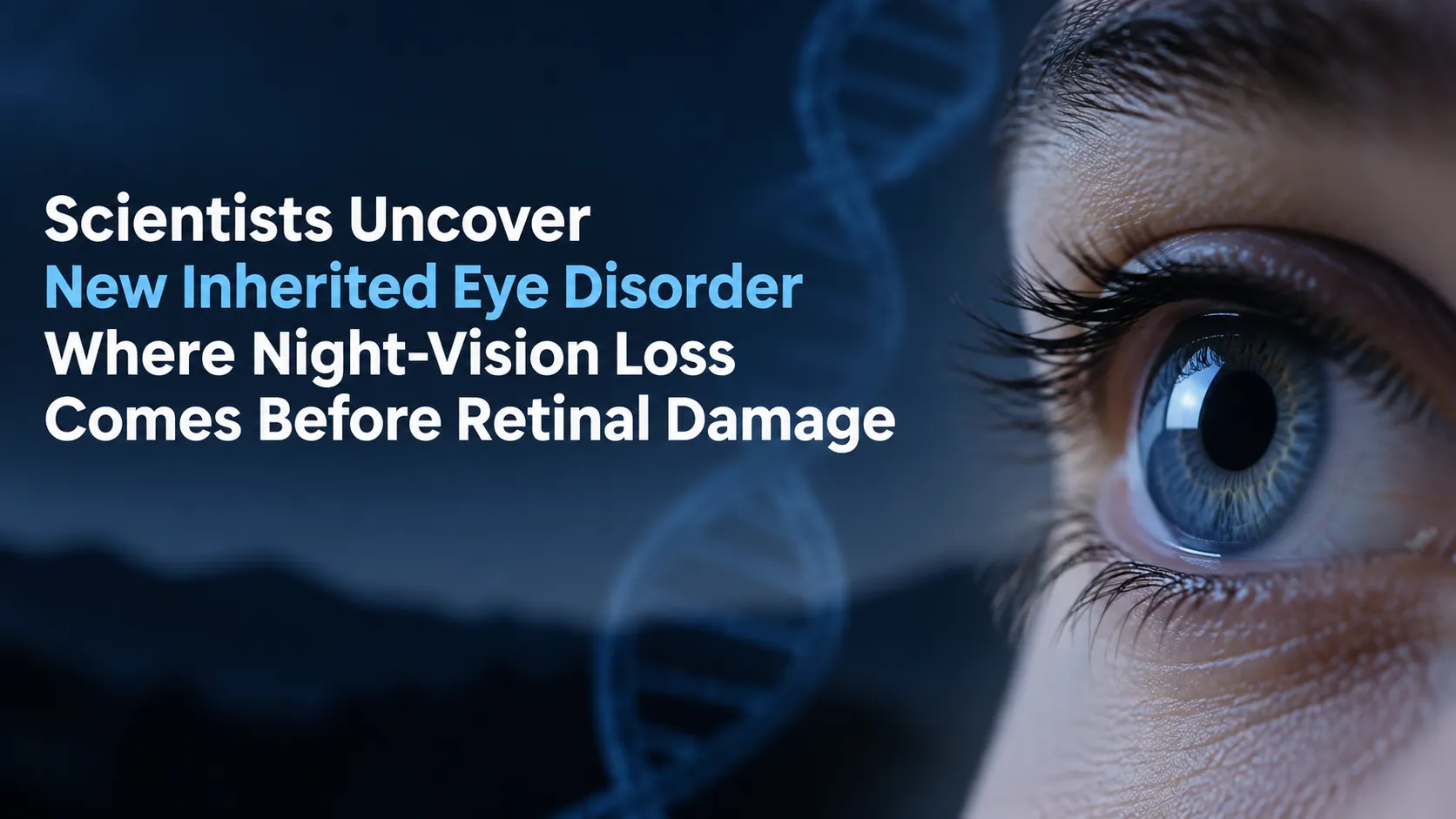
An international team of researchers has identified a previously unrecognized inherited retinal disorder linked to a rare variant in the EFEMP1 gene. The newly characterized condition primarily affects the peripheral retina and rod photoreceptors involved in vision under low-light conditions, while central vision can remain relatively preserved for many years.
The findings, published in JAMA Ophthalmology, could help explain previously undiagnosed cases of inherited retinal degeneration and highlight the importance of functional testing for detecting retinal disease before structural damage becomes visible during routine eye examinations.
Researchers from the University Hospital and University of Bonn, along with colleagues from the universities of Edinburgh, Basel and Pennsylvania and other centers in Prague and Philadelphia, investigated three unrelated families carrying the same rare EFEMP1 variant, known as p.Arg140Trp. By combining genetic analysis with detailed clinical assessments and laboratory experiments, the researchers established a connection between the variant and a distinct late-onset form of retinal degeneration.
The newly identified disorder has a characteristic pattern of disease progression. Instead of primarily damaging the central retina, the condition initially targets the peripheral retina and the rod photoreceptors responsible for vision in darkness and dim light. Patients may therefore experience difficulty seeing at dusk or at night and gradually lose peripheral vision, even while their central visual acuity remains normal.
One of the most significant findings was that retinal dysfunction can occur well before visible structural changes appear. In several individuals carrying the p.Arg140Trp variant, researchers detected a pronounced delay in the recovery of rod-mediated vision following exposure to light. At the same time, visual acuity remained normal and conventional retinal examinations showed little or no obvious abnormality.
This suggests that functional testing could identify the disease at an earlier stage than conventional structural examinations. According to the researchers, detecting impaired rod function while photoreceptors are still structurally intact may provide an important window for monitoring disease progression and, potentially, future treatment.
Laboratory investigations also provided clues about how the genetic variant may cause disease. The altered EFEMP1 protein was found to accumulate unusually inside cells, had a greater tendency to form abnormal molecular complexes and was not secreted from cells as efficiently as the normal protein. These changes may contribute to the progressive dysfunction of retinal cells.
The discovery also demonstrates that different variants in the same gene can produce dramatically different inherited eye diseases. EFEMP1 was previously known for its association with Doyne honeycomb retinal dystrophy, also known as Malattia Leventinese. That condition is caused by a different variant, p.Arg345Trp, and predominantly affects the central retina.
In contrast, the newly identified p.Arg140Trp-related disorder has a predominantly peripheral pattern, with relative preservation of the macula—the central retinal region responsible for high-resolution vision. The researchers describe this as an important expansion of the known disease spectrum associated with EFEMP1.
The newly recognized condition may also resemble several other rare retinal disorders, particularly in its later stages. The researchers suggest that EFEMP1 p.Arg140Trp-related disease could potentially account for some cases of inherited retinal disease whose genetic cause has previously remained unexplained.
However, the researchers emphasize that the current findings are based on only three unrelated families. Additional studies involving larger numbers of patients will be required to establish the full clinical spectrum, understand how the disease progresses over time and determine how frequently the newly defined disorder occurs.
The identification of the EFEMP1 p.Arg140Trp variant as a cause of this distinct retinal degeneration adds another example of how a single gene can produce substantially different disease patterns depending on the specific genetic alteration. It also highlights the potential value of detecting changes in retinal function before irreversible structural damage develops.
The study was supported by the BrightFocus Foundation, the German Research Foundation (DFG), and the Samuel G. Jacobson, MD, PhD, Memorial Fund, with additional support for researcher Chloe M. Stanton from the University of Edinburgh and related charitable funding.
Publication : Stanton CM, Ansari G, Pfau K et al. Widening the Spectrum of Disease Expression due to Heterozygous Variants in EFEMP1. JAMA Ophthalmology. DOI: 10.1001/jamaophthalmol.2026.3828.