

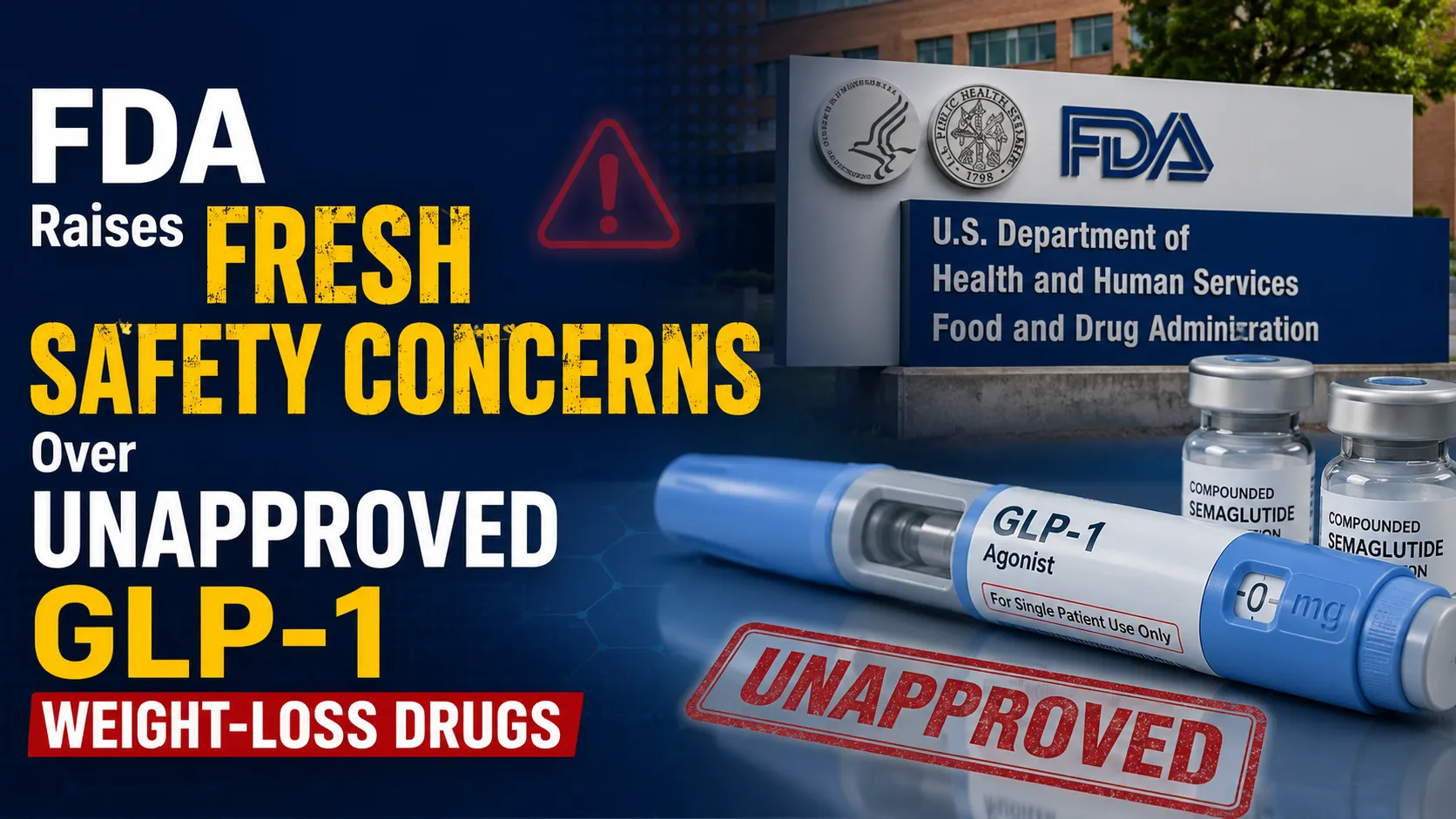
The U.S. Food and Drug Administration (FDA) has issued a detailed warning about the risks associated with unapproved and compounded GLP-1 drugs being used for weight loss, highlighting concerns related to product quality, dosing errors, counterfeit medicines and improper storage.
GLP-1 medicines such as semaglutide and tirzepatide have become widely used for weight management. However, the FDA said unapproved versions do not undergo its review for safety, effectiveness and quality before being marketed. The agency recommends that compounded versions be used only when a patient's medical needs cannot be met by an FDA-approved medicine.
Dosing errors linked to adverse events
One of the FDA's major concerns involves dosing errors with compounded injectable semaglutide and tirzepatide. The agency has received multiple adverse-event reports, including cases requiring hospitalization, associated with patients measuring or administering incorrect doses. Some reports also involved doses exceeding those specified in FDA-approved product labeling.
Reported symptoms included nausea, vomiting, diarrhea, abdominal pain and constipation. The FDA is urging healthcare professionals to carefully assess dosing and titration schedules and advises patients to discuss administration instructions with their healthcare provider or compounder.
Nearly 1,700 adverse-event reports
As of May 31, 2026, the FDA had received 990 adverse-event reports associated with compounded semaglutide and more than 730 reports associated with compounded tirzepatide.
The agency cautioned that these figures may not represent the full extent of adverse events because certain state-licensed pharmacies are not required under federal law to report such events to the FDA. The agency also noted that a reported adverse event does not always establish that the drug itself caused the problem.
FDA flags counterfeit and illegally marketed products
The FDA also said it is aware of fraudulent compounded semaglutide and tirzepatide products carrying false labeling. In some cases, pharmacies named on the labels reportedly did not exist or had not actually compounded the products.
The agency has additionally identified counterfeit Ozempic and illegally marketed semaglutide and tirzepatide. Such products may contain the wrong ingredients, incorrect amounts of active ingredient or potentially harmful substances.
Retatrutide and cagrilintide highlighted
The FDA specifically stated that retatrutide and cagrilintide cannot be used in compounding under federal law. The agency also noted that these substances are not components of FDA-approved drugs and have not been found safe and effective for any condition.
The FDA has taken action against companies involved in marketing unapproved GLP-1 products, including telehealth companies, API distributors and outsourcing facilities.
Concerns over storage and multi-dose vials
The agency has also raised concerns about compounded GLP-1 medicines supplied in multi-dose vials. FDA generally recommends that multi-dose sterile medication vials be used within 28 days after first use because contamination risk increases over time. It advises consumers to discard such vials after 28 days, even if medication remains, and to use a new sterile needle and syringe for every dose.
Improper temperature during shipping is another concern. The FDA has received complaints about injectable compounded GLP-1 products arriving warm or with inadequate cooling and recommends that patients not use injectable products that arrive warm or without sufficient refrigeration.
FDA advises consumers to use licensed pharmacies
The FDA is urging patients to obtain prescriptions from healthcare professionals and fill them through state-licensed pharmacies. Consumers are also advised to be cautious of telehealth providers that offer unusually low prices, make claims that compounded medicines are identical to FDA-approved products, fail to require a prescription or provide inadequate labeling and medical support.
The agency continues to monitor the online market and has issued warning letters concerning illegally marketed GLP-1 products.